Ten years of collaboration were a fitting occasion for Helen Weigel, Deputy Operations Manager of the Salzlandkreis Job Centre, and Sascha Stoik, Managing Director of Mitteldeutsche Wäscherei GmbH, to look back on the collaboration to date and discuss the current labour market situation.
As a family-run company with a long tradition, the STOIK Group specialises in cleaning, full textile supply and textile care and employs a total of 170 people on a production area of around 12,000 square metres at its sites in Berlin and Schönebeck.
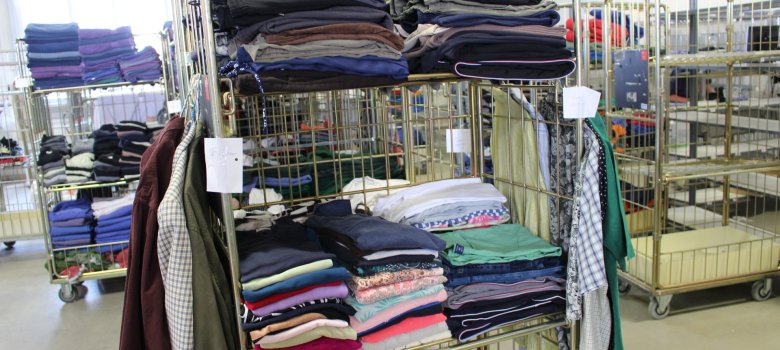
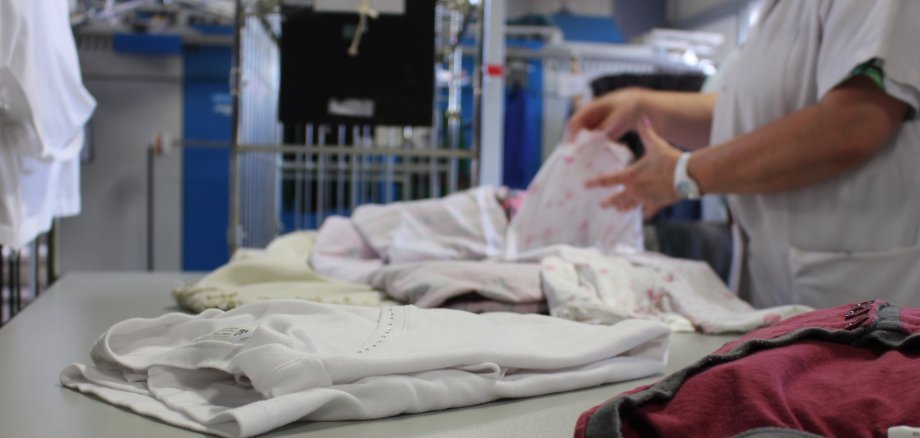
The 55 employees - most of them women - at the Schönebeck site work in two shifts to handle almost 5 tonnes of laundry every day, mainly from retirement and care homes. "A lot of manual labour is required to lay out the garments. A machine can hardly do this, as the sizes and variety of garments vary greatly," reports Managing Director Sascha Stoik. Over the years, more than 20 unemployed or long-term unemployed people from the Salzland district - including 10 Ukrainians, a Syrian and a Vietnamese - have found a permanent job at the industrial laundry in Schönebeck.
The boss can be seen in production almost every day and maintains close contact with his employees. If there is a shortage of staff, the Managing Director is also in the hall himself, loading and unloading the huge, fully automated machines. Stoik actively seeks dialogue with his employees. It is important to him to "take the employees on board" and consider their ideas and suggestions. "Basically, everyone has to be able to do everything here, but we still look at where the employee's strengths lie and what they are good at in order to deploy people accordingly," he reports.
The laundry is always on the lookout for new colleagues for production who can sort the clothes and fill and operate the washing and hot ironing machines. The company also needs support in the area of building services and drivers with a truck driving licence. The search for suitable personnel is proving difficult. On the one hand, there are no public transport connections to the somewhat remote industrial estate, and on the other hand, the dry cleaning sector is also affected by the general shortage of staff.
Stoik reports that he has already been able to help several refugees - including Ukrainians - find a job. He would also be prepared to employ people with physical disabilities. The only thing the entrepreneur cannot offer is a training opportunity, as the profession of dry cleaner or launderer is almost extinct and the nearest vocational school is in Potsdam. The managing director is happy to take on housekeepers or even unskilled labourers - who are then trained on site on the machines and in the processes - as part of his workforce. Stoik welcomes every employee who is willing to come to work every day and is motivated to do their job. He hopes that jobseekers in particular will recognise this opportunity to join the company, to develop within the company or even as a springboard into the industry. Juliane Karg from the employer service at the Salzlandkreis job centre shares this experience: "The range of jobs on the market has improved significantly for jobseekers. It is becoming increasingly difficult for companies to find staff and then retain them in the long term."
The job centre supports companies in their search for suitable employees with advice and, in individual cases, financial subsidies. For example, a refugee - who came to Germany with his wife and two children - was able to sign an employment contract in the janitorial department at Mitteldeutsche Wäscherei after successfully completing a language course and work trial with accompanying support in the context of taking up employment and supported by an integration grant, thanks to the advice offered by the job centre.
Helen Weigel, Deputy Operations Manager and Head of the Integration and Participation Department at the Salzlandkreis Job Centre, explains: "Due to the diverse needs of jobseekers and companies, there is no one-size-fits-all solution. Successful integration of people who have been looking for a job for a long time always requires customised support services that are tailored to both the employer and the employee."
Interested employers can contact the Salzlandkreis Job Centre using the following contact details:
- Telephone: 03471 684-3531
- E-mail: dalbrecht@jc.kreis-slk.de.
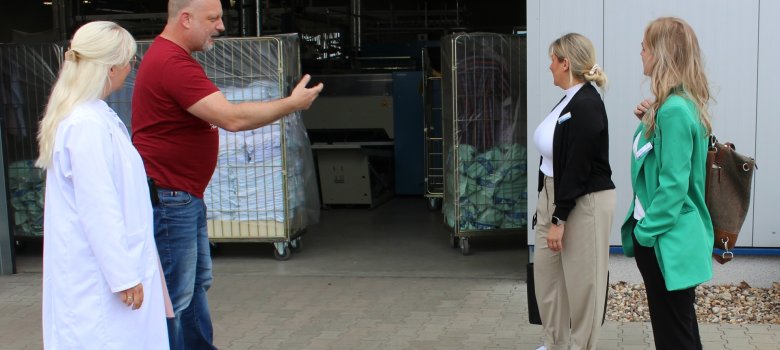
Following the discussion, the visitors were given a tour of the company premises and the production hall to gain an impression of the work processes and activities in the laundry.