
Climate adaptation management Salzlandkreis
© BMUV
On 1 August 2025, the Salzland district set up a climate adaptation management system. The aim of the initial project is to draw up a climate adaptation concept. Climate change presents both risks and opportunities for the Salzland district. As part of the concept, these risks and opportunities are to be identified at an early stage and adaptation measures are to be developed together with various stakeholders.
The development of the climate adaptation strategy is funded bythe Federal Ministry for the Environment, Climate Action, Nature Conservation and Nuclear Safety (BMUKN) under the funding guidelines for adaptation to the consequences of climate change (DAS) as part of the Natural Climate Protection Action Programme (ANK).
Project title: ANK-DAS A.1: Development of a concept for sustainable climate adaptation and natural climate protection for the Salzlandkreis district's own areas of responsibility.
Project duration: 1 August 2025 to 31 July 2027
Funding code: 67DAAN0741
Natural Climate Protection Action Programme
The Natural Climate Protection Action Programme (ANK) promotes a wide range of measures that combine the protection of nature and the climate. By establishing intact ecosystems in rural and urban areas, biodiversity is promoted and at the same time a contribution is made to climate protection by binding carbon dioxide (CO2).
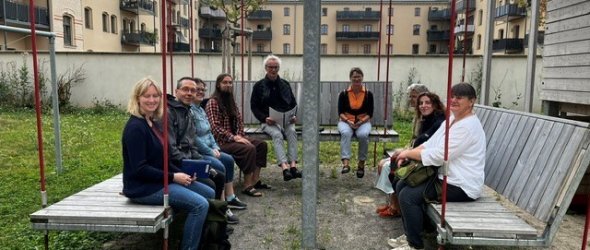
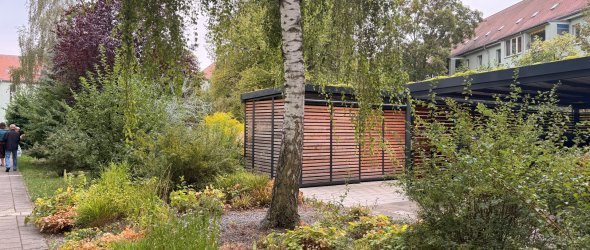
How can towns and cities be designed to be climate-resilient and attractive in times of increasing heat and drought? On 17 August 2026, the Climate Adaptation and Climate Management department of the Salzlandkreis, together with representatives from several municipalities within the district and the city of Halle, explored this question. The Lutherviertel district in Halle (Saale) is renowned nationwide for its innovative concept for utilising rainwater in combination with a climate-resilient courtyard design. On site, the planner responsible explained the wide range of blue-green infrastructure measures.
Rainwater running off the roof surfaces is not ‘disposed of’ into the sewerage system, but is stored in swale ditches in the courtyards and released into the ground at a delayed rate. This water supplies the diverse planting in the courtyards. This includes the existing trees, new trees, perennials, wildflower meadows and lawns. The redesign of the courtyards has enhanced the visual appeal of the residential environment, provides cooling on hot days and has led to a significant increase in demand for the adjacent rental flats.
These elements of water-sensitive urban development also offer benefits to businesses in the wastewater sector. They significantly reduce the volume of stormwater entering the public sewer system and help to manage heavy rainfall events.
A vision for the future of the historic salt works complex: A visit to the SALTSA project
Following the visit to the Lutherviertel, the opportunity was taken to discuss matters with those in charge of the SALTSA project. Launched in spring 2026, the project is dedicated to exploring how unused areas of the historic industrial site can be developed for culture, education and science in the future.
Climate Adaptation Manager
Responsible office